May 29, 2026

AI Didn’t Break The Job Market. It Was Already Broken.
by
Tony Pownall
It’s just allowed people to get it wrong with less effort.
I’ve read a lot about the negative impact of AI on the job market this year. Sure, it’s an elegant solution often applied poorly, but that could be said about a lot of AI applications right now. AI isn’t the root of the recruitment problems identified in the media of late, however; it’s just accentuated many of the problems that already existed. It goes back to the adage of “garbage in, garbage out”, which applies to AI too - let me explain.
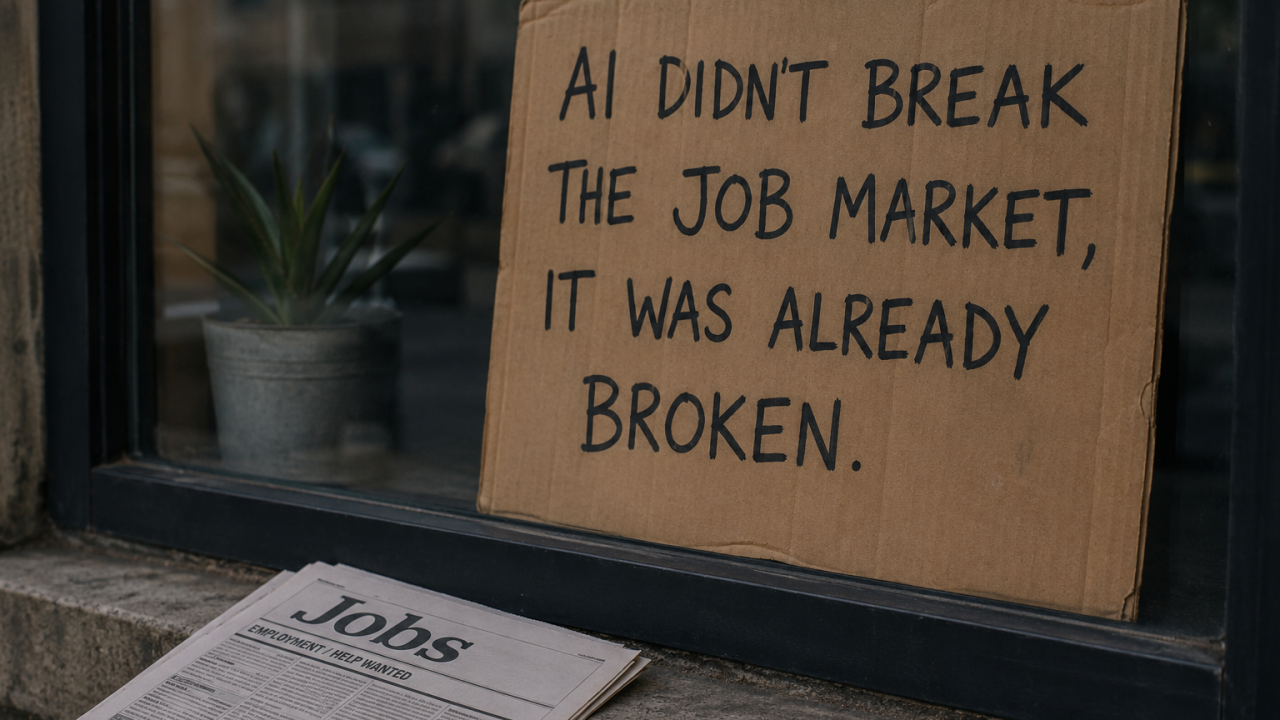
Many of the dynamics and behaviours driving the labour market haven’t changed. AI now means we can judge people by the wrong things faster…even instantly. Great. AI isn’t the problem; it’s how we’re hiring anyway. AI is just a tool that can perpetuate the problem.
Recruitment was already over-indexing on skills and experience
There are a number of underlying factors that can make recruitment problematic, or even flawed:
- NZ’s SME-dominated economy means businesses don’t often have the resources for great onboarding or learning experiences. I saw a lot of L&D teams disappear in the GFC and never really come back, and few leaders seem to have the time or inclination to run really comprehensive onboarding. For many of the new starters we speak to, onboarding doesn’t go far beyond getting your log-ins and a technical how-to guide. This builds a reliance on hiring someone who needs minimal supervision or training and therefore brings all, or very close to all, the skills and experience from day one.
- I’ve seen operational leadership roles become broader and broader over my 22 years recruiting, as businesses trim structures in a process I call “corporate Jenga” – i.e. the process of removing people and resources until engagement and customer experience slump. This trend has eroded leaders’ time to train and coach as they’re busy just holding their unwieldy remits together. This further lifts the expectation on new hires to “hit the ground running”.
- Very few leaders, and a lot of professional recruiters, are ever actually trained on how to recruit well – to articulate what they actually need and then assess that talent accordingly. In a public recruitment workshop I ran for senior leaders last year, only about 10% of the room had ever received prior training. It’s understandable, then, that many leaders get bogged down in aligning technical requirements, because no one has explained that technical match, while easiest to define and judge, is actually one of the lowest indicators of future success. You can train those skills the easiest. Far more powerful is the behavioural and motivational match – but to the untrained these can seem vague and elusive to articulate and measure.
- Few New Zealand organisations are good at workforce planning – which includes identifying current capability gaps against future needs. As a result, even large NZ corporates keep hiring reactively – to fulfil new roles and deliver to new ways of working or a new strategy, but only just before, or at the point of, go-live, despite knowing about and planning that organisational transformation for months or even years. The result is a scramble to hire reactively, rather than identifying and cultivating the missing capabilities over time – building rather than buying. I’ve seen it countless times.
- Talent attraction is a strategic imperative, yet it’s given only operational focus. While executive leaders broadly appreciate that the right talent in the right roles is a massive competitive advantage, the role of making that happen can sometimes be left to junior in-house recruiter(s) with little executive oversight – a disconnect between intent and reality.
- On top of all that, New Zealand is still emerging from the worst recession in a generation, resulting in a rapid swing from the sweeping talent shortages of just two years prior to record numbers of applicants for many roles. So good people are missing out, and companies are less inclined to take on inexperienced “investment” hires like grads when they have more choice of applicants who have done the job before.
You can see the pattern at this point – all of these factors have conspired to bake in, or reinforce, what I see as an unhealthy fixation on skills and experience, despite all the evidence showing experience is a very poor indicator of capability or future success in a role. Ever worked with someone who’s been in their role a long time yet is still ineffective? Exactly. Beyond the initial ramp-up, greater time in the role doesn’t necessarily make for greater performance.
The fact that technology is impacting roles, both how existing work is performed and the creation of new work, at an exponential rate is further exposing the risk in this fixation. The acceleration of skills redundancy is not new. It was about 10 years ago that I first read that much of the knowledge obtained in a typical degree would be outdated by the date of graduation. So it’s not a new concept that we need to favour people who bring the behaviours and attributes, rather than just knowledge.
Nonetheless, we’re largely stuck in a perpetual cycle of hiring for skills and experience – hiring to solve today’s problem, or maybe even yesterday’s, hiring for quick wins, hiring “safe” bets.
And, of course, with the focus of many employers being on skills and experience, is it any wonder the majority of CVs I read focus on just that – like a series of mini job descriptions, listing the tasks people have done in each role, and the tools they’ve used to do them?
Sometimes there’s a list of “strengths” or “competencies” near the top of a CV…generic labels like “hard working”, “excellent communication”, “customer centric”, “strategic”. These words might be true, but they feel hollow and quite frankly meaningless – because anyone can write anything in those lists. They’re not backed by evidence or examples.
So, we have too many hiring managers fixated on what someone has done and too many job seekers therefore only really promoting what they’ve done. And therein lies the heart of the problem, prevalent even before AI emerged.
AI has made a flawed process faster
So let’s now add AI to the mix – increasingly used in recruitment (but never by Cultivate, as you’ll read later) to reduce the funnel of candidates by assessing their CV against the skills and experience criteria, without human intervention. This is merely turbocharging what was happening anyway. Flawed logic, but faster! Excellent.
On the candidate side, applicants are cottoning onto the fact that AI can help polish the language, structure and even content of their CV. It can even ensure the language matches that of the job ad and better highlight aspects of their experience that match.
And so here we are – both sides getting it wrong, and AI making it faster and easier to do so. Bots are crawling CVs for keywords to determine technical capability or experience and, increasingly, judging the bots that are writing them! This absurd point we’ve quickly reached has led to some of the complaints we’re reading about, like insensitive-feeling instant rejections to applications.
So what do we do about it? How do we break the cycle? Here is my advice:
What employers should do instead
Employers, we have to dial down the focus on skills and experience and play up behavioural or cognitive fit, as well as motivational and career fit. If the opportunity aligns with someone’s personal or professional drivers and they bring the attributes or behaviours that are most critical, then they’ll pick up the technical aspects, typically faster than we expect. They might even bring a fresh perspective to how a role could be delivered compared to someone highly experienced and therefore institutionalised… increasingly important given the pace at which technology and roles are evolving. They’ll also likely be more engaged and less expensive, as they are taking your role to learn as well as deliver.
Before you hire, ask yourself three questions:
- What is the minimum skill and experience you really need on day one, and what can you build on? Often this list ends up being shorter than we initially expected.
- What 2-4 behaviours are most critical for high performance? How will someone need to think or act in the role to perform at a high level? These can be hard questions to answer, so you can reframe them as: “What causes your highest performer in the role to succeed?” or “What was great, and not so great, about the person leaving the role?” If it’s a new role: “What would your future hire be doing to excel in the role in 12 months?”
- Why would the right candidate take your role and stay? What’s in it for them?
These questions seem simple enough, but are actually hard to get clear and measurable enough. But once you do, this preparation sets you free to focus on aligning what’s truly important – and you know exactly what you’re looking for in advance, rather than knowing it when you see it.
What job seekers should do instead
Job seekers, you need to move away from a CV only being a description of your work experience, supplemented with an empty or unproven list of “strengths” or “capabilities”. Sure, an employer might need to know what systems or tech you’re proficient in, but it also needs to be written through the lens of what you’re proud of – your achievements and capability – not just knowledge and experience. It needs to sell you, not just describe you.
Think back to examples of success, results of note, feedback from stakeholders, project work you took on, support or mentoring you gave others, ideas or improvements you put forward, efficiency or adaptation you brought to your role, or any examples that demonstrate dedication and commitment, adaptability, problem solving etc. If your CV is dominated with these things, then what you were responsible for in each role will be implied.
Keep track of proof or examples of your achievements, as they’re hard to recall months or years later. Some people update their CV as a live document; others keep an inbox or digital file of evidence they can use for future CV iterations. Only then, once you stack your draft CV with this information, can you use AI to polish the copy and make those highlights shine – but the end result will be far more compelling than a list of “duties”.
As both sides pivot away from the fixation on skills and experience, we realise that AI use needs to be carefully considered and aligned to what’s actually important for success. It’s also clear that recruitment still requires human intervention and judgement to align capability and motivations – thank goodness. Even when AI is used in candidate attraction, or even selection, the best recruiters are also paid to be brokers too – able to build the psychological contract necessary to ensure the right candidate ultimately starts in the role.
Where Cultivate stands on AI
We made the decision very early on to not use AI to judge talent. Recruitment is too nuanced and CVs are too often poor reflections of what their author is actually capable of, or willing to do, as I’ve explained. As a result, there is a lot of further investigation needed beyond basic CV screening. We use AI daily, but only for eliminating the administration aspects, so we have more time to support hiring managers to create a measurable and balanced brief, and more time helping job seekers to uncover and articulate their value proposition.